For children aged 7 to 11, their parents and teachers
Quick, checked facts on the Key Stage 2 topics children get set for homework, from the Romans and the Vikings to rivers, the Moon and times tables, each with free links to the BBC, museums and NASA.
Pick a topic, read the five facts, open one of the links, then write what you learned in your own words. There’s also a calm, one-task-at-a-time homework routine for children who find homework hard to start.
- No ads, no sign-up
- Free to print and share (CC BY 4.0)
- Every link checked on October 19, 2026
Pick your homework topic
Topics are grouped the way most primary schools in England group them. Tap one to jump straight to its facts.
Help with homework
How to use a topic in four steps
- Read the factsFive short facts give you the big picture.
- Learn three wordsThe “words to know” are the ones teachers look for.
- Open one linkPick one free site and look for one new fact.
- Write it your wayClose the page, then write or draw what you remember.
History homework help
History topics jump around in time, so it helps to know where each one sits. The timeline shows the order. Dates with BC count down toward year 1; dates with AD count up from it.
British history timeline for Key Stage 2
- up to about 2500 BCStone AgeHunters, then the first farmers. Work on Stonehenge began around 3000 BC.
- from about 2500 BCBronze AgeMetal tools made from copper and tin.
- from about 800 BCIron AgeHill forts, tribes and iron tools.
- AD 43 to about AD 410Roman BritainRoads, towns, baths and Hadrian’s Wall.
- about AD 410 to 1066Anglo-Saxons and VikingsKingdoms, raids and Alfred the Great.
- 1066Battle of HastingsThe Normans take over England.
- 1485 to 1603TudorsHenry VIII and Elizabeth I.
- 1837 to 1901VictoriansFactories, railways and new schools.
- 1939 to 1945World War TwoEvacuation, rationing and the Blitz.
Ancient Egypt (from around 3000 BC) and ancient Greece (most famous around 2,500 years ago) happened far away, at the same time as Britain’s Stone, Bronze and Iron Ages.1, 2
History
Stone Age to Iron Age (and the Celts)
Prehistory, up to AD 43
Five quick facts
- The Stone Age gets its name because people made their tools from stone. It has three parts: the Palaeolithic (early), Mesolithic (middle) and Neolithic (new) Stone Age.3
- Cheddar Man, found in a cave in Somerset in 1903, lived about 10,000 years ago. He is the oldest almost complete skeleton of a modern human found in Britain.4
- Work on Stonehenge began about 5,000 years ago. Some of its smaller stones, the bluestones, came from Wales, more than 150 miles away.5
- Skara Brae, on the Orkney Islands, is a stone village where farmers lived around 5,000 years ago. Even the beds and shelves are made of stone.6
- The Bronze Age began in Britain around 2500 BC, and the Iron Age around 800 BC. Iron Age people lived in tribes, often in hill forts. The Celts lived in Britain from about 750 BC until the Romans came.7, 8, 9
Try this: draw a roundhouse and label what it was made from.
History
The Romans in Britain
AD 43 to about AD 410
Five quick facts
- Julius Caesar visited Britain with an army in 55 and 54 BC, but the real invasion came in AD 43, when Emperor Claudius sent a large army that landed in Kent.10
- Around AD 60, Queen Boudicca of the Iceni tribe led a rebellion and burned Colchester and London before the Romans defeated her.10
- Work on Hadrian’s Wall began in AD 122. It runs 73 miles from coast to coast and guarded the northern edge of the Roman Empire.11, 12
- The Romans built about 10,000 miles of road in Britain. Some modern roads still follow them, such as the Fosse Way.13
- By about AD 410, Rome itself was under attack, and the last Roman soldiers left Britain.13
Try this: find three English words that come from Latin, the Romans’ language.
History
The Anglo-Saxons
About AD 410 to 1066
Five quick facts
- After the Romans left, new people crossed the North Sea: the Angles, Saxons and Jutes, from lands that are now Germany, the Netherlands and Denmark.14
- England is named after the Angles. The Anglo-Saxons were farmers and skilled craftspeople who made fine jewelry and metalwork.14
- In 1939, archaeologists at Sutton Hoo in Suffolk uncovered the shape of a buried ship full of treasure. It may have been the grave of King Rædwald of East Anglia, who died around 624.15, 16
- Alfred the Great was King of Wessex from 871 to 899. He fought the Vikings and then made peace with them.17
- Anglo-Saxon rule ended at the Battle of Hastings on 14 October 1066, when Duke William of Normandy defeated King Harold.18
Try this: look for town names ending in -ham, -ton or -ford near you. Many are Anglo-Saxon.
History
The Vikings
AD 793 to 1066
Five quick facts
- The Vikings came from Norway, Sweden and Denmark. They sailed to new lands partly because there was not enough farmland at home.19
- In AD 793, Vikings attacked the monastery at Lindisfarne, an island off the coast of north-east England.20
- Not all Vikings were raiders. Many came to settle and farm, and lived in long, one-room homes called longhouses.21
- King Alfred and the Viking leader Guthrum agreed that Vikings could live in the north and east of England. This area was called the Danelaw.19, 20
- In 954, the Anglo-Saxons drove out Eric Bloodaxe, the last Viking king of Jorvik (York). The Viking age in England ended in 1066.20
Try this: on a map, trace a sea route from Norway to York.
History
The Tudors
1485 to 1603
Five quick facts
- Five Tudor kings and queens ruled England: Henry VII, Henry VIII, Edward VI, Mary I and Elizabeth I.22
- Henry VII became king in 1485 after he defeated Richard III at the Battle of Bosworth Field.22
- Henry VIII reigned from 1509 to 1547 and married six times. He broke away from the Pope in Rome and made himself head of the Church of England.23
- Henry VIII’s warship, the Mary Rose, sank in 1545 during a battle with the French. It was raised from the seabed in 1982.24
- Elizabeth I, Henry VIII’s daughter, was queen from 1558 to 1603. She was the last Tudor ruler.22, 25
Try this: make a family tree of the five Tudor monarchs.
History
The Victorians
1837 to 1901
Five quick facts
- The Victorian period is named after Queen Victoria, who reigned from 1837 to 1901.26, 27
- Steam engines powered new factories and trains. By 1851, more people in Britain lived in towns and cities than in the countryside.28
- Factory work was long, noisy and dangerous. Children crawled under machines to collect loose thread, and many were hurt.28
- The Education Act of 1870 set up new “board schools” where they were needed. In 1880, school became compulsory for children aged 5 to 10.29
- The British Empire grew to its largest during Victorian times, bringing in materials such as metals, sugar and tobacco.27
Try this: compare a Victorian classroom with yours. What is the same?
History
World War Two
1939 to 1945
Five quick facts
- Germany invaded Poland on 1 September 1939. Britain and France declared war on Germany two days later, on 3 September.30
- Evacuation, called Operation Pied Piper, began in September 1939. Children were moved from cities to the countryside to keep them safe from bombs.31
- Food rationing started in January 1940, so that everyone got a fair share.32
- The Blitz was the heavy bombing of British cities from September 1940 to May 1941. More than 43,500 civilians were killed.30, 31
- The war in Europe ended on 8 May 1945, now called VE Day. The war against Japan went on until August 1945.33
Try this: write a postcard home from an evacuee’s point of view.
History
Ancient Egypt
About 3000 BC to 30 BC
Five quick facts
- Around 3000 BC, people began building settlements along the River Nile, which gave them water and good land for crops. Their civilization lasted about 3,000 years.1
- The Great Pyramid of Giza is about 4,600 years old. It was built as a tomb for a pharaoh, the name for an Egyptian ruler.1
- Hieroglyphs were one of the earliest writing systems, with around 700 signs. The Rosetta Stone, found in 1799, helped people read them again.34
- Jean-François Champollion did much of the work of decoding hieroglyphs in 1821 and 1822.35
- In 1922, Howard Carter discovered the tomb of the boy pharaoh Tutankhamun. Egypt became part of the Roman Empire in 30 BC.36, 37
Try this: design a cartouche, an oval with your name in picture symbols.
History
Ancient Greece
Most famous about 2,500 years ago
Five quick facts
- About 2,500 years ago, Greece was one of the most important places in the ancient world. It was made up of city-states, each with its own laws and leaders.2
- The first Olympic Games were held in 776 BC at Olympia, in honor of the god Zeus. Winners got a crown of olive leaves.38, 39
- The earliest Olympic event was a running race of about 200 meters, called the stade.38
- In Athens, citizens voted on decisions, an early form of democracy. Only men could be citizens; women and enslaved people had no vote.40
- Our alphabet is based on the Greek one, and hundreds of English words come from Greek.40
Try this: find five English words that begin with “tele”, “photo” or “micro”. All three come from Greek.
Geography homework help
Geography is about places and the way they change. Most Key Stage 2 homework starts with rivers, mountains, rainforests or reading a map.
Geography
Rivers
From source to sea
Five quick facts
- A river starts at its source, usually on high ground, and flows until it reaches a lake, the sea or another river.41
- Rivers bend in loops called meanders as they go around hills and rocks.41
- Rivers are part of the water cycle: water evaporates, condenses into clouds, falls as rain and flows back to the sea.41, 42
- The River Severn is the longest river in the UK. London grew up on the River Thames.43
- People use rivers for drinking water, farming, transport and fun, and human activity can pollute them.41, 43
Try this: find the nearest river to your home on a map, and follow it to the sea.
Geography
Mountains and volcanoes
How the land is pushed up
Five quick facts
- Mountains are higher and usually steeper than hills, generally over 600 meters high. A group of them is a mountain range.44
- The tallest mountain in the UK is Ben Nevis in Scotland, 1,345 meters high.45
- The longest mountain range on land is the Andes in South America, which runs for over 7,000 kilometers.44
- A volcano is an opening in the Earth’s crust. Melted rock underground is called magma; once it comes out, it is called lava.46, 47
- Many volcanoes form where the plates of the Earth’s crust meet or move apart.44, 47
Try this: draw a volcano cut in half and label the magma chamber, vent and crater.
Geography
Rainforests
Hot, wet and full of life
Five quick facts
- A biome is a large area with its own climate, plants and animals. Tropical rainforests are hot and wet all year round.48
- The Amazon in South America holds nearly a third of the world’s remaining tropical rainforest.49
- The Amazon covers about 1% of the planet’s surface, but is home to about 10% of all known wildlife species.49
- More than 70% of the world’s jaguars live in the Amazon.49
- Around 47 million people live in the Amazon, including about 2.2 million Indigenous people, and people have lived there for around 14,000 years.49
Try this: list five foods in your kitchen that first came from rainforest plants, then check with an adult.
Geography
Continents, oceans and maps
Finding your way around the world
Five quick facts
- There are seven continents: Africa, Antarctica, Asia, Europe, North America, Oceania and South America.50
- Five oceans cover around three-quarters of the planet: the Atlantic, Pacific, Indian, Southern and Arctic. They are all connected.51
- Europe is the second smallest continent and has over 40 countries.50
- The Prime Meridian, the line of 0° longitude, passes through London.50
- Russia is the world’s largest country by area, and it spreads across both Europe and Asia.50
Try this: name a country on every continent except Antarctica.
Science homework help
Key Stage 2 science asks children to explain how things work. The best homework answers use a science word and say why.
Science
Earth, Sun and Moon
Days, years and the phases of the Moon
Five quick facts
- There are eight planets in our Solar System. Until 2006, Pluto was counted as a ninth.52
- The Earth spins once about every 24 hours, which gives us day and night.53
- The Earth travels once around the Sun in about 365 days: one year.54
- The Moon makes no light of its own. Moonlight is sunlight bouncing off it.55
- The Moon goes around the Earth in about 27.3 days, but it takes about 29.5 days to go from one new moon to the next.55
Try this: draw the Moon every clear night for two weeks and see the phases change.
Science
The human body
Skeleton, heart, digestion and teeth
Five quick facts
- An adult has 206 bones. Babies have around 300, but some join together as they grow.56, 57
- Your heart is a muscle about the size of your fist. It pumps blood, which carries oxygen and nutrients around your body.58
- For most people, the heart beats 60 to 100 times a minute. You can feel it when you take your pulse.59
- Stretched out, an adult’s small intestine would be about 5 to 7 meters long.60
- Adults have 32 teeth.61
Try this: count your pulse for one minute, then again after jumping for one minute.
Science
Plants
What plants need and how they make seeds
Five quick facts
- Plants are living things. To grow and stay alive they need water, light, the right temperature, nutrients, air, and room and time to grow.62
- Water soaks into the soil, enters through the roots and travels up the stem to the leaves.62
- Leaves make food for the plant. Without enough water, a plant wilts and can’t make enough food.62
- Flowers make seeds. First they need pollen from another flower, usually carried by insects such as bees. This is pollination.63, 64
- Fruit protects the seeds and helps spread them to new places.64
Try this: put a stick of celery in colored water overnight and watch where the color goes.
Science
Electricity
Circuits, conductors and staying safe
Five quick facts
- Every circuit needs a power source. A single battery is properly called a cell; two or more cells together make a battery.65
- Electricity only flows when the circuit is a complete loop. A switch opens or closes the gap.65
- Conductors, such as metals, let electricity flow through them easily. Insulators, such as plastic and rubber, do not.66
- Scientists draw circuits with symbols so anyone can read them.65
- Dry your hands before touching anything electrical, and never stick anything into a plug socket.67
Try this: make a list of ten things at home and sort them into conductors and insulators.
Math homework help
Little and often works best for math facts. Ten minutes a day on one times table beats an hour once a week. For more practice, NRICH (University of Cambridge), Oak National Academy and BBC Bitesize KS2 Maths are all free.
Math
Times tables
Up to 12 × 12
Five quick facts
- In England, every Year 4 pupil in a state-funded school takes the multiplication tables check, held over two weeks in June.68
- The check has 25 timed questions and tests whether children can recall their times tables up to 12 fluently.68
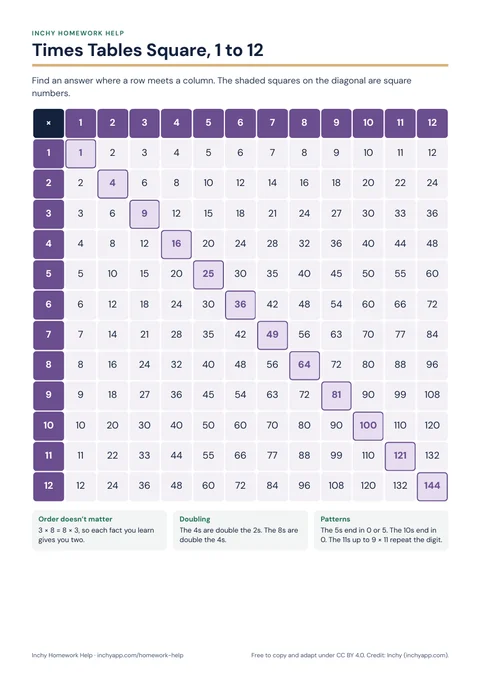
- Order doesn’t matter: 3 × 8 is the same as 8 × 3. Learning one fact gives you two.
- The 5 times table always ends in 0 or 5, and the 10 times table always ends in 0.
- Doubling helps: the 4 times table is double the 2s, and the 8 times table is double the 4s.
The government says future assessment arrangements, including this check, are under review following a 2025 curriculum report.68 The last three facts are arithmetic you can check with the square below.
Multiplication square
Square numbers are shaded on the diagonal. Find any answer where a row meets a column. On a phone, swipe the square sideways to see 8 to 12.
| × | 1 | 2 | 3 | 4 | 5 | 6 | 7 | 8 | 9 | 10 | 11 | 12 |
|---|---|---|---|---|---|---|---|---|---|---|---|---|
| 1 | 1 | 2 | 3 | 4 | 5 | 6 | 7 | 8 | 9 | 10 | 11 | 12 |
| 2 | 2 | 4 | 6 | 8 | 10 | 12 | 14 | 16 | 18 | 20 | 22 | 24 |
| 3 | 3 | 6 | 9 | 12 | 15 | 18 | 21 | 24 | 27 | 30 | 33 | 36 |
| 4 | 4 | 8 | 12 | 16 | 20 | 24 | 28 | 32 | 36 | 40 | 44 | 48 |
| 5 | 5 | 10 | 15 | 20 | 25 | 30 | 35 | 40 | 45 | 50 | 55 | 60 |
| 6 | 6 | 12 | 18 | 24 | 30 | 36 | 42 | 48 | 54 | 60 | 66 | 72 |
| 7 | 7 | 14 | 21 | 28 | 35 | 42 | 49 | 56 | 63 | 70 | 77 | 84 |
| 8 | 8 | 16 | 24 | 32 | 40 | 48 | 56 | 64 | 72 | 80 | 88 | 96 |
| 9 | 9 | 18 | 27 | 36 | 45 | 54 | 63 | 72 | 81 | 90 | 99 | 108 |
| 10 | 10 | 20 | 30 | 40 | 50 | 60 | 70 | 80 | 90 | 100 | 110 | 120 |
| 11 | 11 | 22 | 33 | 44 | 55 | 66 | 77 | 88 | 99 | 110 | 121 | 132 |
| 12 | 12 | 24 | 36 | 48 | 60 | 72 | 84 | 96 | 108 | 120 | 132 | 144 |
Practice, no timer
Pick a table. You get ten questions in a mixed order. There’s no clock, so take your time.
This practice needs JavaScript. Use the square above instead.
Math
Fractions
Parts of a whole
Five quick facts
- A fraction shows equal parts of a whole. The bottom number, the denominator, is how many equal parts the whole is split into.69
- The top number, the numerator, is how many of those parts you have.69
- A unit fraction has a numerator of 1, like ½ or ¼.69
- Equivalent fractions look different but are worth the same, like ½ and 2⁄4. Multiply or divide the top and bottom by the same number to find them.70
- The bigger the denominator, the smaller each piece: ¼ of a pizza is a smaller slice than ½.
Try this: fold a piece of paper to show ½, then ¼, then ⅛.
Math
Shapes and angles
Turns, triangles and polygons
Five quick facts
- Angles are measured in degrees. A full turn is 360° and a half turn is 180°.71
- A right angle is exactly 90°, like the corner of a book. Acute angles are smaller than 90°; obtuse angles are between 90° and 180°.71
- The angles inside any triangle add up to 180°. Inside a four-sided shape they add up to 360°.72, 73
- An equilateral triangle has three equal sides, an isosceles triangle has two, and a scalene triangle has none.73
- A right-angled triangle is any triangle with a right angle in it.73
Try this: go on a right-angle hunt at home. How many can you find in one room?
English homework help: reading, spelling and grammar
Most English homework is reading, spellings or a grammar sheet. Reading every day, even for ten minutes, is the habit that helps most.
English
Grammar and spelling words teachers use
Key Stage 2 terms
Five quick facts
- A fronted adverbial is a word or phrase at the start of a sentence that says when, where or how something happened, like “Earlier today,”.74
- Fronted adverbials are usually followed by a comma.74
- Homophones sound the same but are spelled differently and mean different things, like “hear” and “here” or “see” and “sea.”75
- Nouns name things, verbs are doing or being words, adjectives describe nouns and adverbs describe verbs.
- For spellings, “look, say, cover, write, check” works: look at the word, say it, cover it, write it from memory, then check.
Try this: write three sentences about your weekend, each starting with a different fronted adverbial.
Six world religions
Religious education (RE) homework often asks about holy books, founders and places of worship. Here are the six religions most primary schools in England study, in the words BBC Bitesize uses.
Christianity
Focused on the life and teaching of Jesus, who was born in Bethlehem over 2,000 years ago.
- Holy book
- the Bible
- Worship
- many Christians worship in churches
Islam
Muslims believe in one God, Allah, and that Islam was revealed over 1,400 years ago in Makkah through the Prophet Muhammad.
- Holy book
- the Qur’an
- Worship
- a mosque
Judaism
Began nearly 4,000 years ago in the Middle East.
- Holy book
- the Torah, the first five books of the Hebrew Bible
- Worship
- a synagogue
Hinduism
Over 4,000 years old, one of the world’s oldest religions. Hindus believe in a supreme God, Brahman.
- Holy texts
- include the Vedas
- Worship
- a mandir
Sikhism
Founded by Guru Nanak around 500 years ago in the Punjab.
- Holy book
- the Guru Granth Sahib
- Worship
- a gurdwara
Buddhism
Started in India over 2,500 years ago. Buddhists follow the teachings of Siddhattha Gotama, the Buddha.
- Holy texts
- the Tripitaka
- Worship
- a temple
More: BBC Bitesize KS2 Religious Education, which also covers Humanism.
Finding good information for a homework project
Searching the whole internet brings up adverts, games and pages written for grown-ups. Start with sites made for learning, then check what you find.
Start with a trusted site
Try BBC Bitesize, a museum, NASA Space Place or the links on this page before a general search.
Check who wrote it
Look for a museum, university, charity or government name at the bottom of the page.
Find it twice
If a fact matters, such as a date or a number, find it on a second site before you use it.
Write it your way
Read, close the page, then write. Copying whole sentences isn’t learning, and teachers can tell.
Say where it came from
Write the site’s name at the end, like “Source: BBC Bitesize.”
Free sites made for learning
- BBC Bitesize PrimaryEvery KS1 and KS2 subject
- National Geographic KidsAnimals, places and science
- NASA Space PlaceSpace and Earth science
- ESA KidsThe European Space Agency’s site for children
- Natural History Museum: DiscoverDinosaurs, nature and fossils
- KidsHealthYour body and health
- The National Archives: EducationReal historical documents
- Met Office: learn about weatherWeather and climate
Your public library card may also give free online access to encyclopedias for children. Ask at your library.
A calmer homework routine, one task at a time
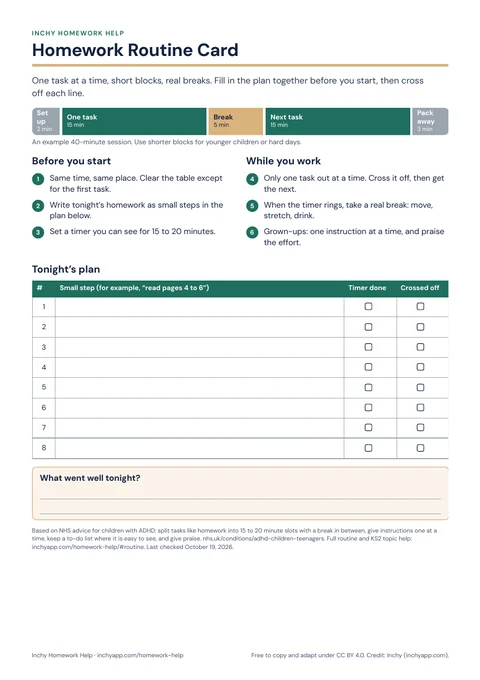
For many children, the hardest part of homework is starting. That’s especially true for children with ADHD, who can find it hard to listen, follow instructions or stay on one task. The NHS suggests a few simple changes at home: split homework into 15- to 20-minute slots with a break between each, give clear instructions one at a time, keep a to-do list where it’s easy to see, and praise effort.82 The routine below builds on those suggestions. It works for most children, diagnosis or not.
- Same time, same place. A regular slot (for example, after a snack) means fewer arguments about when. Clear the table of everything except the one task.
- Write the list together. Break tonight’s homework into small, concrete steps (“read pages 4 to 6”, not “English”) and put the list where your child can see it.82
- One task at a time. Only the first step is on the table. When it’s done, it gets crossed off, and the next one comes out.
- Use a timer for 15 to 20 minutes. A visible timer makes the end feel close. When it rings, stop for a short break, even mid-task.82
- Make breaks real breaks. Move, stretch, get a drink. Screens tend to swallow the next block, so leave them for afterward.
- One instruction at a time, calmly. “Start with question one” works better than a list of reminders.82
- Praise the effort, not just the answers. Notice getting started, staying with it and finishing a block. A simple reward chart can help.82
- Talk to school if it’s too much. If homework regularly ends in tears, tell the class teacher or the school’s SENCO (special educational needs coordinator). They can talk through support with homework.82
If you think your child might have ADHD
Speak to your child’s teacher or SENCO, or to a GP or health visitor. In the US, talk to your child’s doctor; the CDC notes that training for parents in behavior management is part of recommended treatment, and that schools can be part of it too.82, 83 This page is general information, not medical advice.
Inchy is a focus app built around the same idea: one task at a time. You don’t need it to use anything on this page. The Homework Routine Card below does the same job on paper.
Printables
A4 PDFs. Print them for home, the classroom or a homework club.
Link to this page from your homework page
Every link checked on October 19, 2026
Many school websites still link to Primary Homework Help (primaryhomeworkhelp.co.uk), the topic pages Mandy Barrow wrote that began as Woodlands Junior School’s homework resources.84 That address no longer loads. When we checked on October 19, 2026, the domain no longer existed. If your “useful links” or homework page points to it, this page covers the same Key Stage 2 topics with checked facts and free links. There are no ads and no sign-up.
Copy a ready-made link
<a href=”https://inchyapp.com/homework-help/”>Homework help for primary school: KS2 topics, facts and free links</a>
Link straight to a topic
Add the topic name to the end of the address:
/homework-help/#history#romans#anglo-saxons#vikings#tudors#victorians#ww2#egypt#greece#stone-age#timeline#geography#rivers#mountains#rainforests#science#space#body#plants#electricity#maths#times-tables#fractions#shapes#english#religions#routine
License
The text of this page and the printables are licensed under Creative Commons Attribution 4.0 International (CC BY 4.0). Print them, share them or adapt them for your class. Just credit Inchy and link back here.
Suggested citation (APA 7)
Inchy. (2026). Homework help for primary school: Key Stage 2 topics, quick facts and free resources. https://inchyapp.com/homework-help/
How this page is checked
Every fact is checked against the source cited next to it, mostly BBC Bitesize, museums, NASA and government pages. Every outside link was opened and checked on the date above. Spotted a mistake or a broken link? Please tell us. Changes are logged on our corrections page.
Sources
Each source was opened and checked against this page on October 19, 2026. Facts with no number next to them are simple arithmetic or general study advice.
- BBC Bitesize. (n.d.). An introduction to Ancient Egypt (KS2). British Broadcasting Corporation. Retrieved October 19, 2026. https://www.bbc.co.uk/bitesize/topics/zg87xnb/articles/z6x2382
- BBC Bitesize. (n.d.). Who were the ancient Greeks? (KS2). British Broadcasting Corporation. Retrieved October 19, 2026. https://www.bbc.co.uk/bitesize/topics/z87tn39/articles/zxytpv4
- BBC Bitesize. (n.d.). What is the Stone Age? (KS2). British Broadcasting Corporation. Retrieved October 19, 2026. https://www.bbc.co.uk/bitesize/topics/z82hsbk/articles/zfg9bqt
- Natural History Museum. (n.d.). Cheddar Man: Mesolithic Britain’s blue-eyed boy. Retrieved October 19, 2026. https://www.nhm.ac.uk/discover/cheddar-man-mesolithic-britain-blue-eyed-boy.html
- English Heritage. (n.d.). Stonehenge: history and stories. Retrieved October 19, 2026. https://www.english-heritage.org.uk/visit/places/stonehenge/history-and-stories/
- BBC Bitesize. (n.d.). Skara Brae: a Neolithic village (KS2). British Broadcasting Corporation. Retrieved October 19, 2026. https://www.bbc.co.uk/bitesize/topics/z82hsbk/articles/z2ym6g8
- BBC Bitesize. (n.d.). What was life like in the Bronze Age? (KS2). British Broadcasting Corporation. Retrieved October 19, 2026. https://www.bbc.co.uk/bitesize/topics/z82hsbk/articles/z874kqt
- BBC Bitesize. (n.d.). What was life like in the Iron Age? (KS2). British Broadcasting Corporation. Retrieved October 19, 2026. https://www.bbc.co.uk/bitesize/topics/z82hsbk/articles/z8bkwmn
- BBC Bitesize. (n.d.). Who were the Celts? (KS2). British Broadcasting Corporation. Retrieved October 19, 2026. https://www.bbc.co.uk/bitesize/topics/z82hsbk/articles/zqp2m39
- BBC Bitesize. (n.d.). How did the Romans conquer Britain? (KS2). British Broadcasting Corporation. Retrieved October 19, 2026. https://www.bbc.co.uk/bitesize/topics/zqtf34j/articles/zx2hhcw
- English Heritage. (n.d.). History of Housesteads Roman Fort. Retrieved October 19, 2026. https://www.english-heritage.org.uk/visit/places/hadrians-wall/history-and-stories/history/
- English Heritage. (n.d.). Hadrian’s Wall. Retrieved October 19, 2026. https://www.english-heritage.org.uk/visit/places/hadrians-wall/
- BBC Bitesize. (n.d.). How did the Romans change Britain? (KS2). British Broadcasting Corporation. Retrieved October 19, 2026. https://www.bbc.co.uk/bitesize/topics/zqtf34j/articles/z2dr4wx
- BBC Bitesize. (n.d.). Who were the Anglo-Saxons? (KS2). British Broadcasting Corporation. Retrieved October 19, 2026. https://www.bbc.co.uk/bitesize/topics/zxsbcdm/articles/zq2m6sg
- National Trust. (n.d.). History of Sutton Hoo. Retrieved October 19, 2026. https://www.nationaltrust.org.uk/visit/suffolk/sutton-hoo/history-of-sutton-hoo
- Encyclopaedia Britannica. (n.d.). Sutton Hoo. Retrieved October 19, 2026. https://www.britannica.com/place/Sutton-Hoo
- BBC Bitesize. (n.d.). Who was Alfred the Great? (KS2). British Broadcasting Corporation. Retrieved October 19, 2026. https://www.bbc.co.uk/bitesize/topics/zxsbcdm/articles/z9tdq6f
- BBC Bitesize. (n.d.). Why was the Norman Conquest important? (KS2). British Broadcasting Corporation. Retrieved October 19, 2026. https://www.bbc.co.uk/bitesize/topics/zxsbcdm/articles/z3s9j6f
- BBC Bitesize. (n.d.). Who were the Vikings? (KS2). British Broadcasting Corporation. Retrieved October 19, 2026. https://www.bbc.co.uk/bitesize/topics/ztyr9j6/articles/zjcxwty
- BBC Bitesize. (n.d.). What happened to the Anglo-Saxons and the Vikings? (KS2). British Broadcasting Corporation. Retrieved October 19, 2026. https://www.bbc.co.uk/bitesize/topics/ztyr9j6/articles/z8q487h
- BBC Bitesize. (n.d.). An introduction to Viking Britain (KS2). British Broadcasting Corporation. Retrieved October 19, 2026. https://www.bbc.co.uk/bitesize/topics/ztyr9j6/articles/zshvvwx
- Encyclopaedia Britannica. (n.d.). House of Tudor. Retrieved October 19, 2026. https://www.britannica.com/topic/house-of-Tudor
- Historic Royal Palaces. (n.d.). Henry VIII, terrible Tudor?. Retrieved October 19, 2026. https://www.hrp.org.uk/hampton-court-palace/history-and-stories/henry-viii/
- The Mary Rose Trust. (n.d.). History of the Mary Rose. Retrieved October 19, 2026. https://maryrose.org/discover/history/
- Encyclopaedia Britannica. (n.d.). Elizabeth I. Retrieved October 19, 2026. https://www.britannica.com/biography/Elizabeth-I
- Encyclopaedia Britannica. (n.d.). Victoria, queen of the United Kingdom. Retrieved October 19, 2026. https://www.britannica.com/biography/Victoria-queen-of-United-Kingdom
- BBC Bitesize. (n.d.). Who were the Victorians? (KS2). British Broadcasting Corporation. Retrieved October 19, 2026. https://www.bbc.co.uk/bitesize/topics/zp2sxg8/articles/zdvwrmn
- BBC Bitesize. (n.d.). How did life change for Victorian workers? (KS2). British Broadcasting Corporation. Retrieved October 19, 2026. https://www.bbc.co.uk/bitesize/topics/zp2sxg8/articles/zd3jcxs
- UK Parliament. (n.d.). The 1870 Education Act. Retrieved October 19, 2026. https://www.parliament.uk/about/living-heritage/transformingsociety/livinglearning/school/overview/1870educationact/
- Imperial War Museums. (n.d.). Second World War. Retrieved October 19, 2026. https://www.iwm.org.uk/history/second-world-war
- BBC Bitesize. (n.d.). What was the Blitz and why were people evacuated? (KS2). British Broadcasting Corporation. Retrieved October 19, 2026. https://www.bbc.co.uk/bitesize/topics/zsxytcw/articles/zcn9vj6
- BBC Bitesize. (n.d.). How did people’s lives change during World War Two? (KS2). British Broadcasting Corporation. Retrieved October 19, 2026. https://www.bbc.co.uk/bitesize/topics/zsxytcw/articles/z6ktjfr
- Imperial War Museums. (n.d.). What you need to know about VE Day, 8 May 1945. Retrieved October 19, 2026. https://www.iwm.org.uk/history/what-you-need-to-know-about-ve-day
- BBC Bitesize. (n.d.). What were Egyptian hieroglyphs? (KS2). British Broadcasting Corporation. Retrieved October 19, 2026. https://www.bbc.co.uk/bitesize/topics/zg87xnb/articles/zvw3mfr
- Encyclopaedia Britannica. (n.d.). Rosetta Stone. Retrieved October 19, 2026. https://www.britannica.com/topic/Rosetta-Stone
- BBC Bitesize. (n.d.). Who was Tutankhamun? (KS2). British Broadcasting Corporation. Retrieved October 19, 2026. https://www.bbc.co.uk/bitesize/topics/zg87xnb/articles/zvmkhbk
- BBC Bitesize. (n.d.). How did ancient Egyptian civilisation end? (KS2). British Broadcasting Corporation. Retrieved October 19, 2026. https://www.bbc.co.uk/bitesize/topics/zg87xnb/articles/zqykkty
- BBC Bitesize. (n.d.). How did the Olympic Games begin? (KS2). British Broadcasting Corporation. Retrieved October 19, 2026. https://www.bbc.co.uk/bitesize/topics/z87tn39/articles/z36j7ty
- International Olympic Committee. (n.d.). The ancient Olympic Games. Retrieved October 19, 2026. https://www.olympics.com/ioc/ancient-olympic-games
- BBC Bitesize. (n.d.). How did the ancient Greeks change the world? (KS2). British Broadcasting Corporation. Retrieved October 19, 2026. https://www.bbc.co.uk/bitesize/topics/z87tn39/articles/z8q8wmn
- BBC Bitesize. (n.d.). What are rivers? (KS2). British Broadcasting Corporation. Retrieved October 19, 2026. https://www.bbc.co.uk/bitesize/topics/z849q6f/articles/zx4j2v4
- Met Office. (n.d.). The water cycle. Retrieved October 19, 2026. https://www.metoffice.gov.uk/weather/learn-about/weather/how-weather-works/water-cycle
- BBC Bitesize. (n.d.). Longest rivers in the UK (KS2). British Broadcasting Corporation. Retrieved October 19, 2026. https://www.bbc.co.uk/bitesize/topics/zttbcmn/articles/zjnbg7h
- BBC Bitesize. (n.d.). What are mountains? (KS2). British Broadcasting Corporation. Retrieved October 19, 2026. https://www.bbc.co.uk/bitesize/topics/z849q6f/articles/zyhf3j6
- BBC Bitesize. (n.d.). Tallest mountains in the UK (KS2). British Broadcasting Corporation. Retrieved October 19, 2026. https://www.bbc.co.uk/bitesize/topics/zttbcmn/articles/zwp3bqt
- BBC Bitesize. (n.d.). What are volcanoes? (KS2). British Broadcasting Corporation. Retrieved October 19, 2026. https://www.bbc.co.uk/bitesize/topics/z849q6f/articles/zfhf3j6
- British Geological Survey. (n.d.). Volcanoes. Retrieved October 19, 2026. https://www.bgs.ac.uk/discovering-geology/earth-hazards/volcanoes/
- BBC Bitesize. (n.d.). What are biomes? (KS2). British Broadcasting Corporation. Retrieved October 19, 2026. https://www.bbc.co.uk/bitesize/topics/z849q6f/articles/z2kj2v4
- WWF-UK. (n.d.). The Amazon. Retrieved October 19, 2026. https://www.wwf.org.uk/where-we-work/amazon
- BBC Bitesize. (n.d.). The geography of Europe (KS2). British Broadcasting Corporation. Retrieved October 19, 2026. https://www.bbc.co.uk/bitesize/topics/zsw4kty/articles/z4tg4xs
- BBC Bitesize. (n.d.). What are the five oceans of the world? (KS2). British Broadcasting Corporation. Retrieved October 19, 2026. https://www.bbc.co.uk/bitesize/topics/z849q6f/articles/zkr8jsg
- BBC Bitesize. (n.d.). What is the Solar System? (KS2). British Broadcasting Corporation. Retrieved October 19, 2026. https://www.bbc.co.uk/bitesize/topics/zkbbkqt/articles/zsnx7yc
- BBC Bitesize. (n.d.). Day and night (KS2). British Broadcasting Corporation. Retrieved October 19, 2026. https://www.bbc.co.uk/bitesize/topics/zkbbkqt/articles/zn34r2p
- NASA Space Place. (n.d.). How long is a year on other planets?. Retrieved October 19, 2026. https://spaceplace.nasa.gov/years-on-other-planets/en/
- NASA Science. (n.d.). Moon phases. Retrieved October 19, 2026. https://science.nasa.gov/moon/moon-phases/
- BBC Bitesize. (n.d.). What does your skeleton do? (KS2). British Broadcasting Corporation. Retrieved October 19, 2026. https://www.bbc.co.uk/bitesize/topics/zcyycdm/articles/zf284xs
- Nemours KidsHealth. (n.d.). Your bones. Retrieved October 19, 2026. https://kidshealth.org/en/kids/bones.html
- Nemours KidsHealth. (n.d.). Your heart and circulatory system. Retrieved October 19, 2026. https://kidshealth.org/en/kids/heart.html
- BBC Bitesize. (n.d.). The circulatory system (KS2). British Broadcasting Corporation. Retrieved October 19, 2026. https://www.bbc.co.uk/bitesize/topics/zcyycdm/articles/z9w9r2p
- BBC Bitesize. (n.d.). What is the digestive system? (KS2). British Broadcasting Corporation. Retrieved October 19, 2026. https://www.bbc.co.uk/bitesize/topics/zcyycdm/articles/z8bntrd
- BBC Bitesize. (n.d.). Teeth (KS2). British Broadcasting Corporation. Retrieved October 19, 2026. https://www.bbc.co.uk/bitesize/topics/zcyycdm/articles/z8784xs
- BBC Bitesize. (n.d.). What do plants need? (KS2). British Broadcasting Corporation. Retrieved October 19, 2026. https://www.bbc.co.uk/bitesize/topics/zy66fg8/articles/zk43f82
- BBC Bitesize. (n.d.). Pollination and seed spreading (KS2). British Broadcasting Corporation. Retrieved October 19, 2026. https://www.bbc.co.uk/bitesize/topics/zy66fg8/articles/zrrk4xs
- BBC Bitesize. (n.d.). The structure of flowering plants (KS2). British Broadcasting Corporation. Retrieved October 19, 2026. https://www.bbc.co.uk/bitesize/topics/zy66fg8/articles/z2d4g7h
- BBC Bitesize. (n.d.). What are electrical circuits? (KS2). British Broadcasting Corporation. Retrieved October 19, 2026. https://www.bbc.co.uk/bitesize/topics/zj44jxs/articles/zqgfp4j
- BBC Bitesize. (n.d.). What are conductors and insulators? (KS2). British Broadcasting Corporation. Retrieved October 19, 2026. https://www.bbc.co.uk/bitesize/topics/zj44jxs/articles/zhkgvwx
- BBC Bitesize. (n.d.). How to be safe around electricity (KS2). British Broadcasting Corporation. Retrieved October 19, 2026. https://www.bbc.co.uk/bitesize/topics/zj44jxs/articles/z9gk4xs
- Standards and Testing Agency. (2020, updated 2026). Multiplication tables check. Retrieved October 19, 2026. https://www.gov.uk/government/collections/multiplication-tables-check
- BBC Bitesize. (n.d.). What are fractions? (KS2). British Broadcasting Corporation. Retrieved October 19, 2026. https://www.bbc.co.uk/bitesize/topics/zhdwxnb/articles/zd8mt39
- BBC Bitesize. (n.d.). Equivalent fractions (KS2). British Broadcasting Corporation. Retrieved October 19, 2026. https://www.bbc.co.uk/bitesize/topics/zhdwxnb/articles/zbqkvwx
- BBC Bitesize. (n.d.). What is an angle? (KS2). British Broadcasting Corporation. Retrieved October 19, 2026. https://www.bbc.co.uk/bitesize/topics/zb6tyrd/articles/zg68k7h
- BBC Bitesize. (n.d.). Angles in polygons (KS2). British Broadcasting Corporation. Retrieved October 19, 2026. https://www.bbc.co.uk/bitesize/topics/zb6tyrd/articles/z6rsm39
- BBC Bitesize. (n.d.). Types of triangle (KS2). British Broadcasting Corporation. Retrieved October 19, 2026. https://www.bbc.co.uk/bitesize/topics/zvmxsbk/articles/zggsfrd
- BBC Bitesize. (n.d.). What is a fronted adverbial? (KS2). British Broadcasting Corporation. Retrieved October 19, 2026. https://www.bbc.co.uk/bitesize/topics/zwwp8mn/articles/zp937p3
- BBC Bitesize. (n.d.). Homophones (KS2). British Broadcasting Corporation. Retrieved October 19, 2026. https://www.bbc.co.uk/bitesize/topics/zt62mnb/articles/z7g8jhv
- BBC Bitesize. (n.d.). What is Christianity? (KS2). British Broadcasting Corporation. Retrieved October 19, 2026. https://www.bbc.co.uk/bitesize/topics/ztkxpv4/articles/zvfnkmn
- BBC Bitesize. (n.d.). What is Islam and what do Muslims believe in? (KS2). British Broadcasting Corporation. Retrieved October 19, 2026. https://www.bbc.co.uk/bitesize/topics/zpdtsbk/articles/zrxxgwx
- BBC Bitesize. (n.d.). What is Judaism? (KS2). British Broadcasting Corporation. Retrieved October 19, 2026. https://www.bbc.co.uk/bitesize/topics/znwhfg8/articles/zh77vk7
- BBC Bitesize. (n.d.). What is Hinduism? (KS2). British Broadcasting Corporation. Retrieved October 19, 2026. https://www.bbc.co.uk/bitesize/topics/zh86n39/articles/zmpp92p
- BBC Bitesize. (n.d.). What is Sikhism and what do Sikhs believe? (KS2). British Broadcasting Corporation. Retrieved October 19, 2026. https://www.bbc.co.uk/bitesize/topics/zsjpyrd/articles/zkjpkmn
- BBC Bitesize. (n.d.). What is Buddhism? (KS2). British Broadcasting Corporation. Retrieved October 19, 2026. https://www.bbc.co.uk/bitesize/topics/zh4mrj6/articles/zdbvjhv
- NHS. (n.d.). ADHD in children and young people. Retrieved October 19, 2026. https://www.nhs.uk/conditions/adhd-children-teenagers/
- Centers for Disease Control and Prevention. (n.d.). Treatment of ADHD. Retrieved October 19, 2026. https://www.cdc.gov/adhd/treatment/index.html
- Barrow, M. (2013). Primary Homework Help for kids [Archived web page, captured 2024]. Internet Archive. Retrieved October 19, 2026. https://web.archive.org/web/2024/https://www.primaryhomeworkhelp.co.uk/